Pre-Launch AI Chatbot Compliance Checklist (2026)
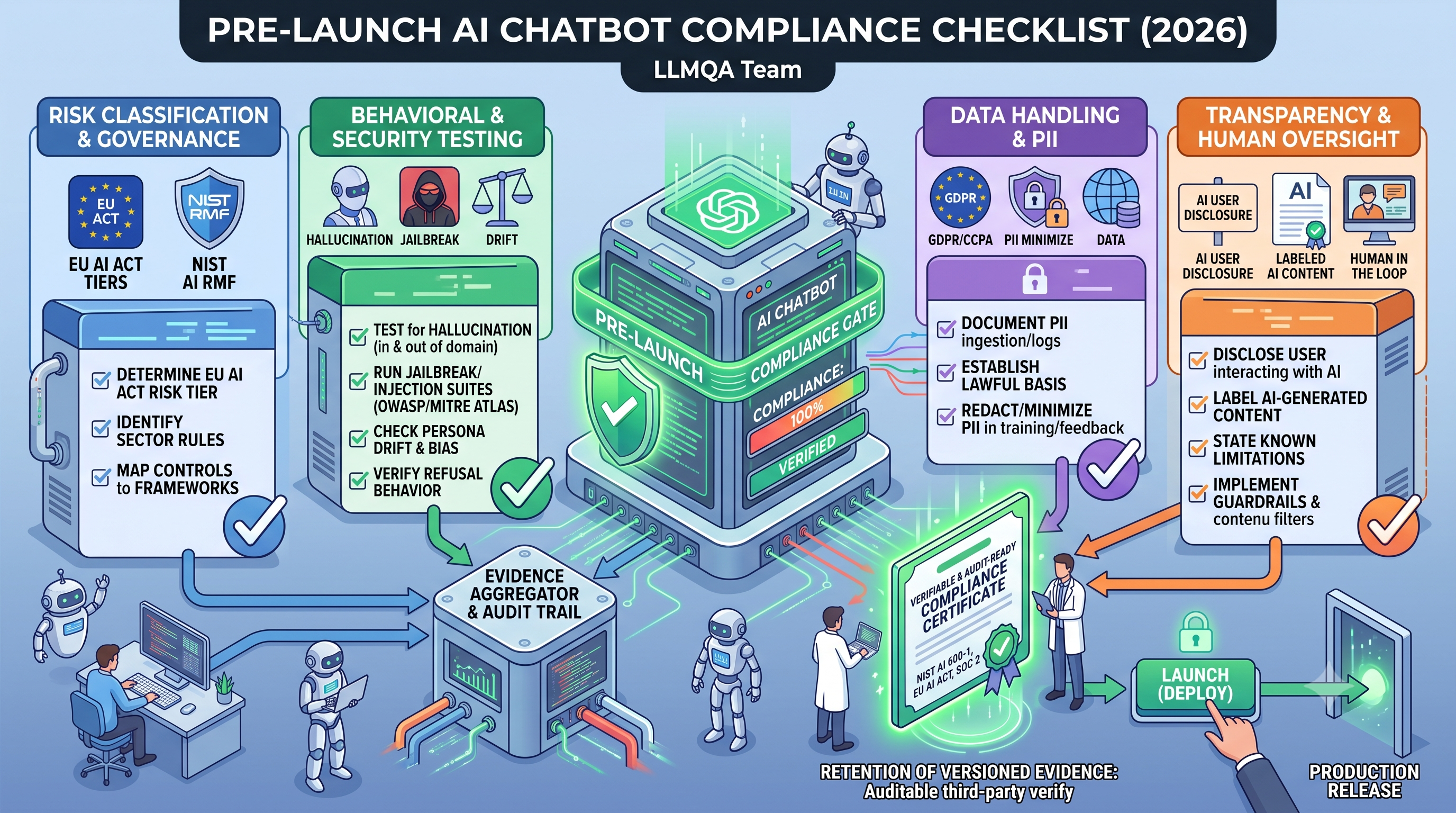
Before launching an AI chatbot in 2026, confirm you can demonstrate four things: that you have classified the system's risk tier (e.g. under the EU AI Act), that you have tested it against safety and security failure modes, that you handle personal data lawfully, and that you have retained audit-ready evidence of all of the above. This checklist walks through the regulatory landscape and turns it into concrete pre-launch actions.
What does "compliance" actually mean for a chatbot in 2026?
For a conversational AI system, compliance is no longer a single sign-off. It is the intersection of several frameworks that each govern a different concern:
- Regulatory risk — primarily the EU AI Act, plus emerging US state laws and sector rules (finance, health, employment).
- Risk management process — frameworks like the NIST AI Risk Management Framework (AI RMF) and its generative-AI profile (NIST AI 600-1).
- Security and operational controls — SOC 2, ISO/IEC 42001, and ISO/IEC 27001.
- Behavioral safety — resistance to hallucination, jailbreaks, persona drift, and bias, often mapped to the OWASP Top 10 for LLM Applications and MITRE ATLAS.
- Data protection — GDPR, CCPA/CPRA, and equivalent regimes governing PII.
The throughline across all of them is evidence. Auditors and regulators do not reward good intentions; they ask what you tested, what you found, and what you did about it.
How do EU AI Act risk tiers apply to chatbots?
The EU AI Act classifies systems into risk tiers, and your obligations scale with the tier. A chatbot can land almost anywhere on this spectrum depending on what it does.
| Risk tier | Typical chatbot example | Key obligations |
|---|---|---|
| Unacceptable | Manipulative or social-scoring bots | Prohibited — do not deploy |
| High-risk | Bots used in hiring, credit, education, or essential services | Conformity assessment, risk management, logging, human oversight, technical documentation |
| Limited / transparency | General customer-support or assistant bots | Disclose that the user is interacting with AI; label AI-generated content |
| Minimal | Internal FAQ helpers, low-stakes tools | Voluntary best practices |
Two points trip teams up. First, transparency duties apply even to "limited-risk" bots: users must be told they are talking to a machine, and synthetic content should be labeled. Second, a seemingly low-stakes assistant can become high-risk the moment it influences a regulated decision. Classify honestly before you build the launch plan, not after.
What does NIST AI RMF expect before launch?
NIST AI RMF is voluntary, but it has become the common vocabulary for "did you manage risk responsibly?" It organizes work into four functions — Govern, Map, Measure, Manage — and the generative-AI profile (AI 600-1) calls out chatbot-specific risks like confabulation, harmful outputs, and data leakage.
Pre-launch, the part auditors care most about is Measure: you should be able to show that you defined risks, tested for them with repeatable methods, and recorded the results. This is exactly where systematic adversarial testing matters — ad-hoc prompt-poking does not produce defensible measurements.
The pre-launch compliance checklist
Work through these before you flip the switch. Treat each unchecked item as a launch blocker until someone with authority signs off on the residual risk.
1. Classification and governance
- [ ] Determine your EU AI Act risk tier and document the reasoning.
- [ ] Identify any sector rules that apply (health, finance, employment, children).
- [ ] Assign a named owner accountable for the system's behavior.
- [ ] Map controls to a recognized framework (NIST AI RMF, ISO/IEC 42001).
2. Behavioral and security testing
- [ ] Test for hallucination on in-domain and out-of-domain queries.
- [ ] Run jailbreak and prompt-injection suites (reference OWASP LLM Top 10, MITRE ATLAS).
- [ ] Check for persona drift — does the bot stay in role over long conversations?
- [ ] Test for bias and unfair outputs across protected attributes.
- [ ] Verify refusal behavior on disallowed and unsafe requests.
- [ ] Re-run the suite against the exact model/version and config you will ship.
3. Data handling and PII
- [ ] Document what personal data the bot ingests, stores, and logs.
- [ ] Establish a lawful basis and honor data-subject rights (access, deletion).
- [ ] Redact or minimize PII in logs and training/feedback loops.
- [ ] Confirm data residency and sub-processor terms with your model provider.
4. Transparency and disclosures
- [ ] Disclose clearly that users are interacting with AI.
- [ ] Label AI-generated content where required.
- [ ] State known limitations and the bot's intended scope.
- [ ] Provide a route to human help or escalation.
5. Human oversight and safety nets
- [ ] Define when and how a human reviews or overrides outputs.
- [ ] Implement guardrails and content filtering at runtime.
- [ ] Set up incident detection and a response/rollback plan.
6. Audit trail and evidence
- [ ] Log prompts, outputs, and key decisions with appropriate retention.
- [ ] Keep technical documentation and a risk-management record.
- [ ] Retain dated, versioned test results tied to the shipped build.
- [ ] Store evidence in a form a third party can independently verify.
How do signed test certificates fit into an audit?
The weakest link in most AI audits is the test evidence itself. A spreadsheet of pass/fail results raises obvious questions: Was it run against the model you actually shipped? Has it been edited since? Who attests to it?
This is where verifiable, cryptographically signed test certificates help. An automated suite like LLMQA stress-tests a chatbot across hallucination, jailbreaks, persona drift, bias, and compliance scenarios, then issues a signed certificate bound to a specific model version and test run. Because the certificate is tamper-evident and independently verifiable, it converts "trust us, we tested it" into something an auditor, customer, or regulator can check directly — and it maps cleanly onto the Measure expectations of NIST AI RMF and the technical-documentation requirements of the EU AI Act.
The point is not the certificate as a trophy. It is having durable, dated, third-party-verifiable proof attached to the exact build you launched.
Frequently asked questions
Is the EU AI Act relevant if my company is outside the EU?
Often yes. The Act can apply when your system's output is used in the EU, regardless of where your company is based — similar in spirit to GDPR's extraterritorial reach. Classify based on where users and effects are, not just where you are incorporated.
Do I need a chatbot to be SOC 2 certified before launch?
SOC 2 is not legally mandatory, but enterprise buyers frequently require it, and it provides a recognized basis for your security and availability controls. For AI-specific risk management, pair it with NIST AI RMF or ISO/IEC 42001 rather than treating SOC 2 alone as sufficient.
What is the single most overlooked pre-launch item?
Audit-ready evidence tied to the shipped version. Teams test thoroughly, then iterate the model and ship a build their evidence no longer describes. Re-test the exact version you launch and retain verifiable proof of it.
Key takeaways
- Compliance for a 2026 chatbot spans regulation (EU AI Act), process (NIST AI RMF), security (SOC 2/ISO 42001), behavior, and data protection.
- Classify your risk tier honestly first; obligations — including transparency — scale from there.
- Test for hallucination, jailbreaks, persona drift, and bias against the exact build you ship.
- Handle PII lawfully, disclose AI use, and keep humans in the loop for consequential decisions.
- Retain dated, version-bound, independently verifiable test evidence — signed certificates from a suite like LLMQA make that evidence audit-ready.


