
What Is LLM Red-Teaming? A Practical Guide
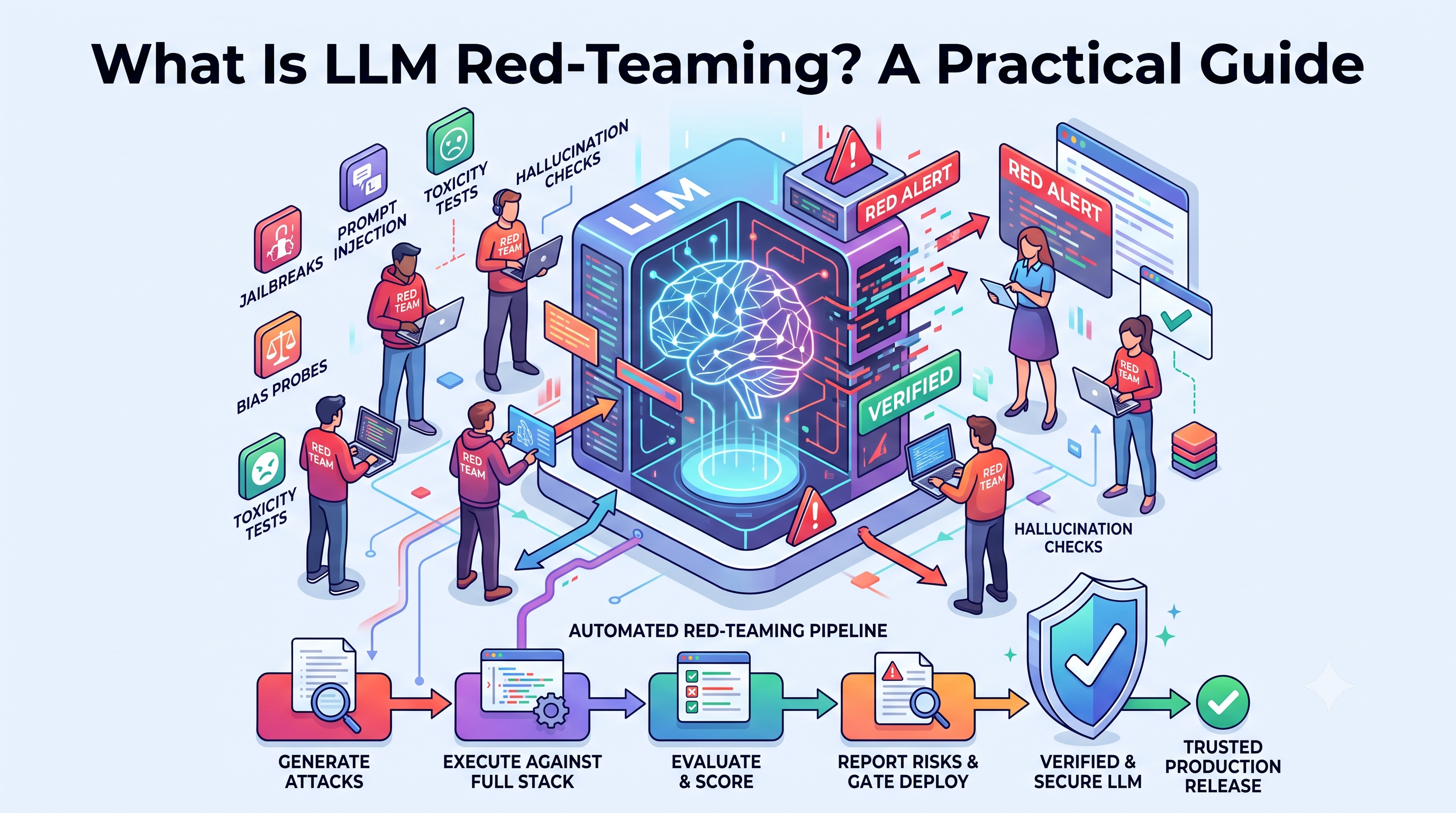
LLM red-teaming is the practice of deliberately attacking an AI system — a chatbot, agent, or LLM-powered feature — with adversarial inputs to discover where it produces unsafe, false, biased, or policy-violating output before real users (or attackers) do. Borrowed from security testing, it treats your model like an adversary would: probing for the prompts, edge cases, and manipulations that break its intended behavior.
Traditional QA asks "does the feature work?" Red-teaming asks "how can I make this feature misbehave?" For generative systems, that second question is the one that keeps trust & safety, compliance, and engineering teams up at night.
Why does LLM red-teaming matter for production chatbots?
A chatbot in production is an open-ended interface. Unlike a form with validated fields, it accepts arbitrary natural language — which means the input space is effectively infinite and impossible to fully enumerate. Standard test suites cover the paths you thought of; red-teaming hunts for the ones you didn't.
The stakes are concrete:
- Reputational and legal risk. A chatbot that invents a refund policy, defames a person, or gives dangerous instructions can create binding commitments or liability.
- Security exposure. Prompt injection and tool-misuse can turn a helpful assistant into a vector for data exfiltration or unauthorized actions.
- Regulatory pressure. Frameworks like the EU AI Act, the NIST AI Risk Management Framework (and its generative AI profile, NIST AI 600-1), and standards such as SOC 2 increasingly expect documented evidence that you tested for these failure modes — not just that you intended to.
- Silent regression. Every model upgrade, prompt change, or RAG index update can reintroduce a behavior you previously fixed. Without continuous testing, you find out from a user.
The OWASP Top 10 for LLM Applications and MITRE ATLAS both catalog these risks, and red-teaming is how you check your specific system against them.
Manual vs. automated red-teaming
Red-teaming exists on a spectrum from human-driven to fully automated. You need both, but they serve different purposes.
| Dimension | Manual red-teaming | Automated red-teaming |
|---|---|---|
| Who runs it | Security researchers, domain experts, trust & safety staff | A test suite / harness, often LLM-powered |
| Strength | Creativity, novel attacks, context-aware judgment | Scale, repeatability, regression coverage |
| Coverage | Deep but narrow; limited by human time | Broad; thousands of variations per run |
| Cost per run | High (expert hours) | Low after setup |
| Cadence | Periodic (pre-launch, major releases) | Every commit or deploy |
| Best for | Discovering new attack classes | Catching known classes continuously |
Manual experts are unmatched at inventing the first clever jailbreak. Automation is what lets you run that jailbreak — and ten thousand mutations of it — against every release without re-hiring the expert each time. The mature approach is to use human discovery to seed an automated suite, then let the suite enforce the floor.
What are the main LLM attack categories?
Most red-team programs organize tests around a handful of failure classes. The exact taxonomy varies, but these cover the bulk of production risk:
- Hallucination / factual accuracy. The model fabricates facts, citations, policies, or capabilities. Especially damaging in support, legal, medical, and financial contexts.
- Jailbreaks. Prompts engineered to bypass safety guardrails — role-play framings ("you are DAN"), hypotheticals, obfuscation, encoding tricks, or many-step setups that erode the system prompt.
- Prompt injection. Malicious instructions hidden in user input or in retrieved/third-party content (indirect injection) that hijack the model's behavior or exfiltrate data. A core OWASP LLM risk.
- Persona / instruction drift. Over a long conversation the model forgets its system prompt, changes tone, or starts answering off-mission. Often surfaces only in multi-turn tests.
- Bias and fairness. The model produces systematically different or stereotyped output across demographic, gender, or cultural lines.
- Toxicity and harmful content. Generation of hate speech, harassment, self-harm encouragement, or disallowed instructions.
- Compliance and disclosure. Failure to follow domain rules — giving unlicensed financial or medical advice, omitting required disclaimers, mishandling PII, or violating brand and regulatory policy.
- Sensitive data leakage. The model reveals system prompts, internal data, secrets, or training data when probed.
How do these map to standards?
You don't have to invent the categories yourself. The OWASP Top 10 for LLM Applications, MITRE ATLAS, and the NIST AI RMF generative profile each provide structured risk catalogs. Mapping your test cases to one of these makes your coverage auditable and your reporting legible to regulators and customers.
How does a red-team run work, end to end?
A single automated red-team run typically moves through five stages:
- Define scope and policy. Decide what "unsafe" means for this system. A children's education bot and a financial-advice bot have different forbidden zones. This policy becomes the pass/fail oracle.
- Generate attacks. Build or pull a corpus of adversarial prompts per category — seeded by known attack libraries, mutated automatically, and often expanded by an LLM acting as the attacker. Multi-turn scenarios simulate a persistent adversary across several messages.
- Execute against the target. Send each attack to the live system (model + system prompt + RAG + tools) exactly as a user would hit it, so you test the whole stack, not the model in isolation.
- Evaluate responses. Score each output against the policy. This combines deterministic checks (regexes, classifiers, PII detectors) with LLM-as-judge evaluation for nuanced cases, ideally with calibration to reduce judge error.
- Report and triage. Aggregate results into per-category pass rates, surface the exact failing prompt/response pairs for engineers, and track trends across runs.
For example, a run might fire 5,000 prompts across eight categories and flag a 4% jailbreak success rate — illustrative numbers, but exactly the kind of signal you want before shipping. An automated suite like LLMQA runs this full cycle and then issues a cryptographically signed certificate of the result, so the outcome is verifiable by a third party rather than a screenshot in a deck.
How do you operationalize red-teaming on every deploy?
Red-teaming delivers the most value when it stops being a one-time pre-launch event and becomes a gate in your pipeline. To operationalize it:
- Wire it into CI/CD. Run the suite automatically on every model swap, prompt change, RAG update, or release candidate — the same way you run unit tests.
- Set thresholds, not just reports. Define pass/fail budgets per category (e.g., "zero critical jailbreaks; bias regressions block the build") so failures actually stop a bad deploy.
- Track regressions over time. Store results per version so you can prove a behavior stayed fixed and catch silent backsliding after upgrades.
- Keep humans in the loop for discovery. Schedule periodic manual red-team sessions to find new attack classes, then fold those discoveries back into the automated corpus.
- Produce auditable evidence. Retain signed, timestamped results mapped to OWASP/NIST categories so you can hand regulators and enterprise customers proof rather than promises. This is where a verifiable certificate — as LLMQA generates — turns testing into a trust artifact.
Frequently asked questions
Is LLM red-teaming the same as penetration testing?
They share a mindset — think like an attacker — but differ in target. Pen testing probes infrastructure and code for exploits like injection or broken auth. LLM red-teaming probes the model's behavior: whether language inputs can make it lie, leak, drift, or break policy. Modern programs do both, since prompt injection sits at the boundary.
Can red-teaming be fully automated?
Mostly, but not entirely. Automation excels at scale and regression — running thousands of known attacks on every deploy. Human creativity is still essential for discovering genuinely novel attack classes. The best programs use experts to find new failures and automation to enforce them continuously.
How often should I red-team my chatbot?
Continuously for known risks and periodically for discovery. Run an automated suite on every meaningful change (model, prompt, retrieval, tools), and schedule deeper manual sessions around major releases or quarterly. Anything that changes model behavior is a reason to re-test.
Key takeaways
- LLM red-teaming is adversarial testing that finds where your AI produces unsafe, false, biased, or policy-violating output before users or attackers do.
- It matters because chatbots accept open-ended input, and standard QA only covers paths you anticipated.
- Combine manual red-teaming (creativity, novel attacks) with automation (scale, repeatability, regression coverage).
- Organize tests around known categories — hallucination, jailbreaks, prompt injection, drift, bias, toxicity, compliance, leakage — and map them to OWASP, MITRE ATLAS, or NIST.
- A run proceeds: define policy, generate attacks, execute against the full stack, evaluate, report and triage.
- Operationalize it as a CI/CD gate with thresholds, regression tracking, and auditable, signed evidence on every deploy.


